
The organisation of the Seasalter Company involves a complex set of relationships within two families and between two families, although these connections still need far more research.
The founder, Dr Isaac Rutton, and original architect of the Seasalter Company, created roles and positions for brothers, sisters, sons, daughters, nephews and possibly nieces. These roles were crucial to the secrecy and efficiency of the organisation.
When William Baldock takes over the business and leases Seasalter Parsonage Farm in 1792 he adopts a similar family pattern with remarkable success.
Although they lease the farm, Dr. Rutton and William Baldock never live there. Family members and acquaintances take up residence.
The Seasalter Parsonage Farm is a key to understanding the structure of the Fraternity and the relationships. Those who occupy it, move on to prominent or distinguished positions in Kent society. But they always keep the Company in mind.
It seems tenure of the farm served like an apprenticeship.
The purpose of this page is not to describe the geneology but the dynamics and importance of individuals to the operation of the Seasalter Company.
It is very much a work-in-progress as accounts are uncovered and new stories emerge. For this reason, the profiles will change over time especially concerning large families such as the Baldocks.
The elusive Dr Isaac Rutton
“Near the Market Place is a large house which was the residence of Dr. Isaac Rutton, a physician of long and extensive practice in the town and neighbourhood, being the eldest son of Matthias Rutton, Esq., of Ashford by Sarah, daughter of Sir Nicolas Toke, of Godinton…
… On further enquiry, I find I am mistaken in speaking of the house as having belonged to Dr. Rutton. The Doctor’s residence was what is now the Ashford Bank, where his coat of arms may still be seen in one of the windows. – Edward Halstead “History of Kent”
Quite a few people have been searching for Dr Isaac Rutton over the centuries. He seems to have shunned the public gaze and when you attempt to connect him with smuggling he disappears into the background. Like those low-level early morning mists that envelope the marshlands of the North Kent landscape Rutton becomes vague and obscure the more you look. But there is no doubt he was the architect of a smuggling enterprise that proved successful for over one hundred years from 1740 to 1854.
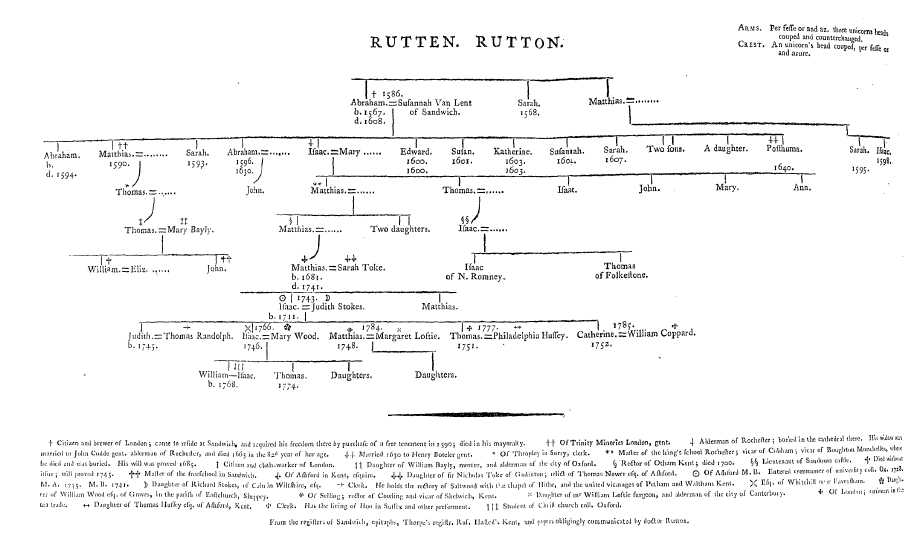
The problems with finding Dr Rutton starts with his name. Under a family genealogy published in 1830 (‘Pedigrees of the Families of Kent’ by William Berry) we see that Berry also uses the name ‘Rutten’ as well as ‘Rutton’ which may suggest Huguenot descent.
 click to enlarge
William Boys appears to have constructed the first genealogy of the Rutton family in 1792. This was part of his ‘Collections for an History of Sandwich’. There are some unresolved issues with his findings but Boys shows us a well-established gentleman of Ashford with a family pedigree traced back as far as 1567.
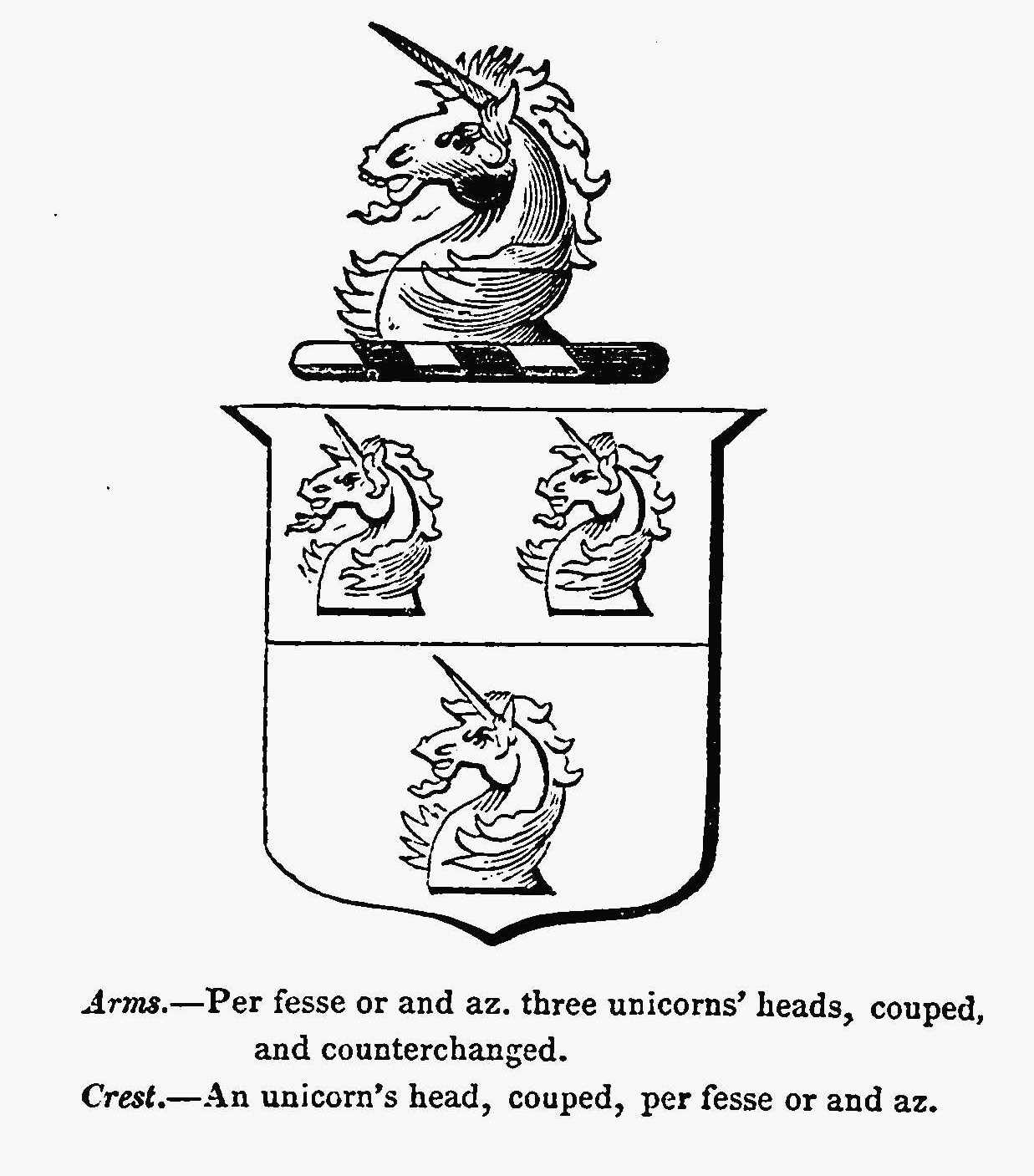 The Ruttons even have a Coat of Arms which includes three unicorn heads couped and counter-changed with the crest of a unicorn’s head. In later investigations, William Berry notes that:
‘It has not been established at what date and to whom these arms were granted. The earliest use yet found is on the gravestone of Mathias Rutton, Vicar at Boughton Monchelsea, Kent (c1613-1686)’.
Other references suggest the arms may have been granted by Henry VII.
Dr Isaac was the son of Matthias Rutton of Ashford, Kent, born in 1681 and died 1741. His mother was Sarah, a daughter of Nicholas Toke of Godington, and the couple were married in August 1709 at Rochester Cathedral.
With such a background you might have thought that the life and times of Dr Rutton would be well-documented but as the opening quote from Edward Halstead’s ‘History of Kent’ demonstrates, just when you think you have him, he eludes you.
Unlike that other later pioneer of the Seasalter Company, William Baldock, Dr Rutton doesn’t appear in public. He is not mentioned in many local events. political gatherings or meetings.
At least with William Baldock you build up the impression of a strong character who rises from humble hod carrier (or a cow herder) to become a pillar of Kent society.
In contrast Dr Rutton remains little more than a quiet Ashford GP. Only through his land purchases and some key appointments do we begin to realise his ability to influence and organise a smuggling fraternity for ‘enterprising’ gentlemen. He designs the organisation in such a way that it will always remain one-step ahead of the authorities. This ability to disguise the activities and anticipate the movements of local militia, dragoons and customs officials will eventually help to create one of the richest men in Kent when William Baldock is given control of the Seasalter Company.
The handover to William Baldock is also a little puzzling. (It seems reasonable to argue that Dr Rutton’s sons were well-prepared by their father to take over the Seasalter operations but like their father they stay very much in the background.) There is no strong link between either Rutton or Baldrock but they evidently knew each other and we have at least one connection through a local solicitor and friend. It might also be that the good Doctor knew Baldock through his mother who was came from a powerful family, the Tokes, and it is Nicholas Roundell Toke who is trusted as an executor to manage the wealth of Baldock in 1812.
Certainly, Dr Rutton recognised something of his own talents and abilities in William Baldock. Also, by the time of the handover, Baldock is a proven success with a set of unique skills and influences that will build on the success of the Company as the times changed.
So, what can we construct about our enigmatic Ashford GP?
Isaac, as we have seen, is a key figure in the town of Ashford. His connection with the Toke family through his mother’s side meant he was born into such a life and his children are also carefully prepared to take up similar respected positions.
The start of his smuggling enterprise begins with purchasing the Seasalter Parsonage Farm in 1740. This renewable 21-year lease will remain at the centre of the organisation’s activity even though Rutton and Baldock never actually live there.
The Seasalter Company made use of the old byways south of the present main road (A229), and continued up Brogdale Road through White Hill. To ensure safe passage, Dr Rutton installs his eldest son first at White Hill and then at Chapel House, Ospringe (which stood above a spacious crypt). This son, Henry Loftie Rutton (1800-1864), is destined to become a successful Kent solicitor and probably managed agreements and contracts on behalf of the Seasalter Company.
His other son Mathias Rutton (1748-1818) studied at Oxford and was ordained by Archbishop Cornwallis. He became Curate of Selling in January 1778 and later at Sheldwich. He was inducted as Rector at Cooling (1783) and then at Badlesmere (1818). Mathias was almost certainly a useful pair of ecclesiastical eyes for Dr Isaac and would have had some influence in the Diocese as one of the Six Preachers of Canterbury and private chaplain to the Barons Sondes.
Here, then, is a sketchy and rather ‘circumstantial’ profile of the man who started the most successful smuggling organisation in North Kent but the portrait is created around associations rather than witnesses and reports.
Dr Rutton is successful because unlike other smuggling gangs in the South East, this one operated largely unnoticed for over 110 years and the scale on which it operated is unquestionable. It was not so much a ‘gang’ as a fraternity of like-minded enterprising gentlemen with strong family connections.
Some researchers have concluded that the Company succeeded because it had a special understanding with the local coast guard including the coast-waiters, riding officers, and customs men but it went further. They had direct family ties. This was pivotal to Dr Rutton’s ambitious plans. He is a classic example of how the gentry were not simply involved in the free-trade but the source and primary funding of smuggling during the 18th and 19th centuries. Our well-respected Ashford GP of long-standing would have grown up acquiring all the local knowledge needed about farmers, fishermen, routes, locations, safe houses.
Quite how much money he made with his enterprise is not documented but we shouldn’t dismiss the scale he operated on. That would have suited the good doctor’s modus operandi only too well because Dr Rutton was after all, a man serving his local community quietly and discretely.
If you have any other information on Dr Isaac Rutton or his family, please do make contact. Particularly interested in any commercial contracts, land agreements, or manifests of cargo.
The impeccable Mr William Baldock
 Gentleman of Petham, brewery owner, race-horse owner, entrepreneur
With William Baldock you build up the impression of a strong character who rises from humble hod carrier (others report him starting life as a cow herder) to become a pillar of Kent society. In 1774 he is listed as a Freeman of the City of Canterbury by Redemption.
Around 1793 he buys an estate in Canterbury known as Saint Gregory’s priory from Stephen Bradley and Henry Irons for £1,175. By September 1804 he had built barracks and other buildings covering 5 acres 1 rod 16 perches, enclosed with a brick wall which was named Saint Gregory’s Barracks. The barracks were leased to HM troops at 6d a week per man and capable of housing up to 2,500 troops.
Just before he dies in December 1812, William sells the barracks to HM Commissioners for the Affairs of Barracks for £25,500. Quite a return!
Using circumstantial news reports and evidence from transaction documents, we can profile Baldock as fiercely political, a successful Canterbury banker, brewer and builder – a man who finally retires to Petham with his racehorses, handing over the management of the Seasalter Company to his son and nephew. From the will we also discover a man who is clever and meticulous in his dealings, protective and loyal to his family and other people who have supported him personally and in business. (He hopes that one beneficiary – a solicitor – will accept a bequest in thanks for the difficult dealings William challenges him to manage.)
The scale of his success is extraordinary. At his death he is estimated to be worth over one million pounds.
If Dr Rutton was the inspiration behind the Seasalter Smuggling Company, William Baldock was the principal architect. He managed the organisation through a succession of adaptions to meet a changing age. He created a most intricate intelligence network infiltrating the South Coast Customs Service and on land, a signalling system that worked from Canterbury to Seasalter and even into London. (It’s said that as dragoons left Canterbury to hunt for free traders, the people of Whitstable and Seasalter would know about it by the time the detail had reached the City walls.)
Thomas Patten. The fiery-tongued vicar of Seasalter who could be bought at the local inn
The church had difficulty in placing vicars at Seasalter. It was regarded by the clergy as an unhealthy place and many barely lasted a year in the position.
One man did remain in the job, however, from 1711 to 1764, Thomas Patten.
The fact that the Church of England had not been able to find a vicar prepared to stay for long in this remote part of Kent, should raise questions concerning the motives behind Reverend Patten’s tenure of 53 years.
Thomas was frequently condemned by the Bishop and shunned by his colleagues, but it seems his parishioners were fond of him.
Revd. Patten referred to himself as the Bishop of Whitstable and his tiny church was no less than a “cathedral”.
He was a man with a frosty temperament and a sharp tongue. Some indication of his character can be found in the parish registers. Here, he makes comments about the severe weather conditions as well as giving us a lively commentary on his flock:
‘The summer of the year 1725 was the most dreadful for continued rains, cold and tempests, that ever any history mentions. Not a day from May to October without rain. The fruits of the earth spoiled. And according to their different religions, some grumbled, some swore, and a few prayed.’
His observations on parishioners were hardly flattering. Against one entry in the marriage register of 1734 we read:
‘John Ponney of Canterbury, Huntsman to that ancient Corporation, and Elizabeth Johnson, daughter to the Devil’s vicegerent, commonly called a Bailiff, were tramelled by licence at the Cathedral of Seasalter, June 6, 1734.
Tom Taylor and his betrothed are also the subjects of the Reverend’s sardonic pen:
‘Old Tom Taylor, the great smoaker of Whitstable, and a deaf old woman called Elizabeth Church, were married at Seasalter with two rings. Oct 29, 1734. Si quis ex successoribus nostris hoc forte legat, rideat si velit.’
And in another comment from the records of 1744 we are introduced to:
‘John Honsden, widower, a young gape-mouthed lazy fellow and Hannah Matthews, hot ‘apont, an old toothless hag, both of Feversham were trammelled by licence in the Cathedral at Seasalter June 6th 1744. A Caspian bowl of well-acidulated Glimigrim.’
Archbishop Thomas Secker, a moderate and modest man by all accounts said:
‘Thomas Patten described as “half mad, impudent, poor” and who died on 9 October, 1764, aged 80 had been vicar of Seasalter since 1711 and perpetual curate of Whitstable.’
Reverend Patten was certainly eccentric. He was also brazen. He wore ragged and dirty clothes to embarrass his Bishop into increasing his stipend and lived quite openly with his mistress. But whatever we make of his behaviour, the parishioners appear to have found some redeeming features in their minister. Neither were the people beyond the ability to manipulate him when the occasion demanded it. The dear reverend often ended his sermon early if a parishioner made an offer to imbibe him at the local Blue Anchor.
Thomas Patten was put in place at the “Cathedral of Seasalter” to be the eyes and ears along that part of the coastline, the surrounding marshes and forestland. He took his duties very seriously.
Revd. Patten was not above using stern measures against smugglers who ignored his presence – especially when they refused to pay a tithe for landing their contraband on his coastline. On one occasion in early 1714, a group of 130 men landed a contraband and Patten reported them to the local customs authorities in a letter. This had two effects:
First, it made smuggling along that part of the coast more hazardous and dangerous for other gangs. The authorities’ attention had been drawn to the location. (The Seasalter Company carried on untroubled because they had family members in the local preventive services. See Jonas King and Richard Hobday Baldock.) Second, it consolidated a perfect disguise for the real presence of this fiery-tongued vicar in the community. Who, after all, would suspect a man of the cloth to be ministering to an extraordinarily well-organised gang of smugglers?
Jonas King: A most untrustworthy, despised and valued man.
In 1794 Jonas King was appointed riding Officer and coastwaiter at Whitstable in the port of Faversham. His annual salary was £25 plus £15 expenses towards keeping a horse. The appointment came from the Board of Customs which meant that Jonas focussed on preventing the movement of smuggled goods which had eluded the Revenue cruisers at sea and the customs officials in the ports.
Jonas came from a well-established Kent family with a father who is described as a ‘gentleman of Dover’ and connected to the Seasalter Company.
With such a background other more lucrative opportunities would have been open to Jonas but the role of riding officer is something of a surprising. Few men were more loathed than the riding officer. The appointment involved patrolling a predetermined area of coastline, liaising with other riding officers (in person or by letter) and gathering local intelligence concerning cargo movements and contraband that might be landing or being held at secret locations. The riding officer always kept a journal which reported his activities and was inspected by the Deputy Receiver General at least once a year.
The position hardly provided an income commensurate with the risks involved. A number of newspaper accounts report officers being attacked by the armed escort (batmen) who accompanied contraband along isolated lanes and tracks. Neither was it a lifestyle anyone would choose if they wanted to be part of the local community. They were regarded with suspicion and even amongst the Customs profession, riding officers were viewed as untrustworthy.
But in the case of Jonas King there were other rewards and the future promise of a comfortable life, later.
Local deeds and reports show that Jonas moved into one of the most imposing properties in Whitstable, complete with stables, coach house and outbuildings. It was hardly the residence of a riding officer and coastwaiter on a salary of £40 per annum.
As his career develops Jonas King starts to acquire parcels of land and property using his own money and funds supplied by the Seasalter Company. Here, we see the typical pattern of how this secretive Company used family members and trusted go-betweens to make purchases of marshland and woodland in the area. Later, Jonas will sell his land to other people connected to the fraternity and it is almost certain that in many cases he was acting as broker and agent rather than land owner. After serving his apprenticeship with the company as a detested government official, Jonas moves to Dover and starts a new career which, of course, flourishes because of his influential connections.
The combined roles of riding officer and coastwaiter gave him a unique view of what was happening along the coastline and in the ports. If Jonas also had access to information on cargo arrivals from foreign ports his information would have been complete. He would know everything concerning the movement of shipping and goods between Faversham and Whitstable and beyond.
Such a source of intelligence was vital to the Seasalter Company. They would have inside knowledge of any smuggling activity in the area (inbound and outbound); they would be forewarned about intelligence and information the authorities might be acting on; they would know about the movement and placement of militia, dragoons and customs men around North Kent, the Medway, and Thames.
As a coastwaiter, we might conclude that Jonas would have been even more ostracized by the community who depended on the free-trade to purchase basic products and avoid poverty. Yet paradoxically, the opposite was true. People within the community probably helped him to maintain his positions knowing that any information he had would be used for free-trade enterprise with, perhaps, a financial reward from the Company.
A few smuggling organisations would have known about Jonas King’s connection to the Seasalter Company but it was a silent acknowledgement – one that could never get back to the authorities. Indeed, these people probably encountered him when they worked in partnership with the Company on a specific enterprise.
The argument for this is the appointment of another riding officer and coastwaiter , Richard Hobday Baldock in 1785 (see below). Between them, Jonas King and Richard Hobday Baldock had control over a substantial part of the North Kent coastline.

Thomas King
The purpose of this page is not to describe the geneology but the dynamics and importance of individuals to the operations of the Seasalter Company.
John King
The purpose of this page is not to describe the geneology but the dynamics and importance of individuals to the operations of the Seasalter Company.
Joseph King
The purpose of this page is not to describe the geneology but the dynamics and importance of individuals to the operations of the Seasalter Company.
Thomas Hyder
The purpose of this page is not to describe the geneology but the dynamics and importance of individuals to the operations of the Seasalter Company.
William Hyder
The purpose of this page is not to describe the geneology but the dynamics and importance of individuals to the operations of the Seasalter Company.
John Knocker
The purpose of this page is not to describe the geneology but the dynamics and importance of individuals to the operations of the Seasalter Company.
Edward Knocker
The purpose of this page is not to describe the geneology but the dynamics and importance of individuals to the operations of the Seasalter Company.
William Knocker
The purpose of this page is not to describe the geneology but the dynamics and importance of individuals to the operations of the Seasalter Company.
Isaac Rutton (son)
The purpose of this page is not to describe the geneology but the dynamics and importance of individuals to the operations of the Seasalter Company.
Matthias Rutton (son)
The purpose of this page is not to describe the geneology but the dynamics and importance of individuals to the operations of the Seasalter Company.
Richard Hobday Baldock (son)
The purpose of this page is not to describe the geneology but the dynamics and importance of individuals to the operations of the Seasalter Company.
Mary Hobday
Mary married Richard Baldock, a brother of William Baldock. Richard appears to have accumulated debts owing to his brother which are cancelled in the Will of Oct 1812. At the time of the will Richard had died. Typically, we can conclude that Mary was taken care of by William and provision is made for her with the granting of a property at Bridge and an annuity of £60 a year for life.
Susan Holtum
The purpose of this page is not to describe the geneology but the dynamics and importance of individuals to the operations of the Seasalter Company.
John Simmons
The purpose of this page is not to describe the geneology but the dynamics and importance of individuals to the operations of the Seasalter Company.
Robert Walker
The purpose of this page is not to describe the geneology but the dynamics and importance of individuals to the operations of the Seasalter Company.
If you have any information or records that might be helpful to this research, please make contact.
 Blue Anchor Corner